
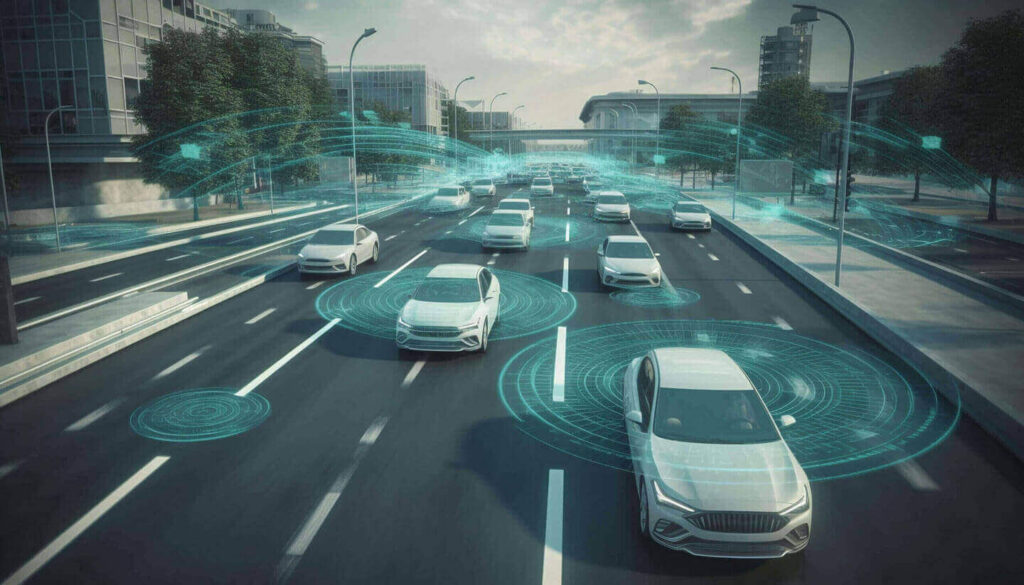

The intersection of fifth-generation wireless technology and autonomous driving is not just a technological milestone. It is a fundamental economic shift that is rewriting the rules of logistics, personal liability, and municipal infrastructure. We are witnessing the dawn of a new era where the asphalt beneath us becomes as intelligent as the devices in our pockets. As we move through late 2025, the theoretical promise of self-driving cars has transitioned into a tangible, data-driven reality that demands our immediate attention.
- The Neural Network of Roads: Understanding 5G URLLC
- V2X Communication: The Holy Grail of Traffic Safety
- Edge Computing and the Data Tsunami
- Cybersecurity: The New Frontline for Fleet Defense
- Liability and Insurance: Who Pays When the Code Crashes?
- Commercial Fleets and the Logistics Overhaul
- Investment Landscape: Where the Smart Money Flows
- Conclusion
This is not merely about cars that drive themselves. It is about the invisible, lightning-fast digital fabric that allows them to “talk” to traffic lights, pedestrians, and insurance databases in milliseconds. For investors, fleet managers, and legal professionals, this convergence represents the single most lucrative opportunity of the decade. This comprehensive guide explores how 5G is the lifeblood of autonomous vehicle (AV) networks and what this means for the global economy.
The Neural Network of Roads: Understanding 5G URLLC
To truly grasp the magnitude of this shift, one must look beyond the vehicle itself and focus on the network. The previous generation of connectivity, 4G LTE, was sufficient for streaming video and navigation apps. However, it lacked the critical speed required for life-or-death decisions on the highway. This is where 5G Ultra-Reliable Low-Latency Communication (URLLC) changes the game.
Autonomous vehicles generate terabytes of data daily. A single Waymo or Cruise vehicle utilizes a suite of LiDAR sensors, radar, and high-definition cameras that must process information instantly. 5G networks reduce latency—the delay between sending and receiving data—to under one millisecond. In practical terms, this means a vehicle traveling at 70 mph can receive a stop command from a smart traffic signal almost instantaneously, reducing the braking distance by critical feet that could save a life.
Telecommunications giants are currently rolling out standalone 5G architectures that prioritize these safety-critical data packets. This infrastructure investment is massive, with carriers deploying small cell towers on street corners to ensure unbroken connectivity. For the automotive industry, this reliability is non-negotiable. A dropped signal is no longer just a buffering video; it is a potential safety hazard.
V2X Communication: The Holy Grail of Traffic Safety
The true power of 5G lies in unlocking Cellular Vehicle-to-Everything (C-V2X) communication. This technology allows a vehicle to communicate with every element of the traffic ecosystem.
Vehicle-to-Vehicle (V2V)
V2V allows cars to exchange speed, position, and heading data. If a truck three cars ahead slams on its brakes, your vehicle knows about it before you even see the brake lights. This predictive capability is expected to reduce rear-end collisions significantly, a metric that auto insurance actuaries are watching closely.
Vehicle-to-Infrastructure (V2I)
Smart cities are installing sensors on traffic lights, stop signs, and road barriers. A 5G-connected car approaches an intersection and “talks” to the traffic light. The light informs the car that it will turn red in 3.5 seconds. The car adjusts its speed smoothly, optimizing fuel consumption and reducing brake wear. This level of coordination is essential for the efficient flow of autonomous taxi fleets in dense urban centers.
Vehicle-to-Pedestrian (V2P)
Perhaps the most critical for safety, V2P connects vehicles with pedestrians’ smartphones. Even if a person is obscured by a parked truck, the 5G network can alert the oncoming autonomous vehicle of the pedestrian’s location, prompting a precautionary slowdown.
Edge Computing and the Data Tsunami
Processing the massive influx of data from millions of vehicles solely in centralized cloud servers is inefficient and too slow. The solution is Mobile Edge Computing (MEC). This architecture moves the processing power closer to the user—literally to the “edge” of the network, such as the base of a cell tower.
Tech giants like Amazon Web Services (AWS) and Microsoft Azure are partnering with telecom providers to deploy these edge zones. By processing critical data locally, an autonomous vehicle can make split-second decisions without waiting for a signal to travel to a data center hundreds of miles away.
For software developers and cloud architects, this shift requires a new approach to application design. Data must be triaged efficiently. Critical navigation data is processed at the edge, while non-critical diagnostics are sent to the central cloud for long-term analysis and machine learning model training. This hybrid approach is fueling a boom in demand for cloud infrastructure services and data center expansion.
Cybersecurity: The New Frontline for Fleet Defense
As vehicles become software-defined platforms, they also become targets. The cybersecurity implications of a fully connected fleet are staggering. A successful hack could theoretically allow an attacker to take control of a vehicle’s steering or braking systems. Consequently, the demand for robust IoT security solutions has skyrocketed.
Automotive cybersecurity is now a top priority for Original Equipment Manufacturers (OEMs). They are deploying intrusion detection systems (IDS) and security operations centers (vSOC) specifically for vehicles. These systems use artificial intelligence to monitor network traffic for anomalies, such as an unauthorized attempt to access the car’s Controller Area Network (CAN bus).
Corporate enterprise security firms are entering this space, offering endpoint protection that secures the API connections between the car and the manufacturer’s server. Ensuring data privacy is also paramount, as these vehicles collect sensitive information about user location and driving habits. Compliance with global data protection regulations is driving legal and technical consulting fees in this sector.
Liability and Insurance: Who Pays When the Code Crashes?
This is the multi-billion dollar question reshaping the legal and insurance landscapes. In a traditional car accident, liability usually falls on the driver who made an error. In an autonomous future, who is responsible?
Is it the manufacturer of the LiDAR sensor?
Is it the telecom provider that dropped the 5G signal?
Is it the software developer who wrote the braking algorithm?
Is it the city that failed to maintain the smart traffic light?
The Shift to Product Liability
Legal experts predict a massive shift from personal auto liability to product liability. Personal injury lawyers are already beginning to specialize in “autonomous vehicle litigation,” a niche that commands incredibly high expertise and value. Law firms are preparing for complex multi-party lawsuits that will require forensic data analysis to determine exactly which system failed.
The Evolution of Insurance Premiums
For the insurance industry, this is an existential transformation. As human error—the cause of over 90% of accidents—is removed, accident frequency will drop, but the severity and cost of claims may rise due to the expensive technology involved. Insurers are pivoting to “usage-based insurance” (UBI) models. These policies use telematics data streamed over 5G to price risk in real-time. If a fleet operates primarily in safe, geofenced areas during daylight hours, their premiums will reflect that lower risk.
Commercial fleet insurance is also adapting. Underwriters are now assessing the quality of a trucking company’s cybersecurity protocols as heavily as they assess their driver training programs. A fleet with outdated firewall protection may face significantly higher deductibles.
Commercial Fleets and the Logistics Overhaul
The immediate economic impact of 5G autonomous networks is most visible in the logistics sector. Long-haul trucking is facing a chronic driver shortage, and autonomous trucks offer a solution that never sleeps (within regulatory limits).
Platooning
5G allows for “platooning,” where a lead truck driven by a human (or fully autonomous) is followed closely by several driverless trucks. The vehicles communicate via V2V to synchronize braking and acceleration perfectly. This reduces wind resistance, cutting fuel costs by up to 15%, a massive margin for logistics companies.
Last-Mile Delivery
In urban areas, small autonomous delivery bots are being tested for last-mile logistics. These devices rely heavily on 5G to navigate crowded sidewalks and communicate with customers. For e-commerce giants, this automated delivery chain represents the final step in reducing shipping costs and increasing delivery speed.
Investment Landscape: Where the Smart Money Flows
For investors, the 5G autonomous ecosystem offers diverse entry points.
- Infrastructure Real Estate: Companies that own the cell towers and fiber optic cables are the landlords of the digital age. Their assets are essential for the 5G rollout.
- Semiconductor Manufacturers: The chips that power edge computing and onboard vehicle AI are in high demand.
- Specialized SaaS Providers: Software companies that offer fleet management, telematics analysis, and cybersecurity compliance are seeing recurring revenue growth.
- Legal and Consulting Services: Firms that guide OEMs through the regulatory maze of autonomous deployment are billing premium rates.
Conclusion
The convergence of 5G and autonomous vehicles is a marathon, not a sprint. We are currently in the crucial deployment phase where infrastructure is being laid and legal frameworks are being tested. For businesses and professionals, staying ahead of this curve is essential. Whether you are in insurance, law, technology, or logistics, the autonomous revolution is powered by connectivity. The data flowing through these networks is the new oil, and 5G is the pipeline.
As we look toward 2026 and beyond, the companies that successfully integrate these technologies will define the future of mobility. The road ahead is digital, it is fast, and it is automated.