
The digital landscape of 2025 has moved past the era of simple cloud adoption. Today, enterprises operate in a sophisticated ecosystem where data resides in multiple locations simultaneously. The challenge is no longer about choosing between a private data center and a public provider. Instead, the focus has shifted toward creating a seamless, high-performance bridge between these environments. Hybrid cloud networking represents the vital circulatory system of modern business, ensuring that information flows securely and efficiently across the divide of physical and virtual infrastructure.
- The Strategic Shift Toward Hybrid Infrastructure in 2025
- Defining the Hybrid Cloud Networking Architecture
- Why Bridging the Gap Matters: Core Business Drivers
- Data Sovereignty and Compliance
- Latency Optimization for Edge Computing
- Disaster Recovery and Business Continuity
- Technical Deep Dive: Connectivity Strategies
- The Security Imperative: Implementing Zero Trust
- AI and Data Acceleration: The 2025 Hybrid Landscape
- Common Challenges in Hybrid Cloud Networking
- Step-by-Step Guide to Implementing a Hybrid Bridge
- Phase 1: Assessment and Planning
- Phase 2: Choosing the Connection Type
- Phase 3: Establishing the Identity Framework
- Phase 4: Pilot Migration and Testing
- Phase 5: Full-Scale Operation and Continuous Optimization
- Future Outlook: Networking Beyond 2025
- Conclusion: The Strategic Importance of the Hybrid Bridge
The Strategic Shift Toward Hybrid Infrastructure in 2025
Recent industry data from late 2025 suggests that over 90 percent of global enterprises have now committed to a hybrid or multi-cloud strategy. This transition is not merely a trend but a fundamental response to the dual needs of high-speed innovation and strict data sovereignty. Public clouds offer unparalleled elasticity for generative AI and massive compute tasks, while on-premise systems provide the localized control required for sensitive financial records, healthcare data, and legacy applications that cannot be easily refactored.
Market Dynamics and Live Growth Statistics
As of December 2025, end-user spending on public cloud services has reached an estimated 723 billion dollars, reflecting a 21.5 percent increase from the previous year. Within this growth, the hybrid cloud segment remains the fastest-growing component. Organizations are increasingly looking to synchronize data across distributed environments, driven by the explosive demand for GenAI capabilities that require both massive public cloud processing power and secure, private data lakes.
The integration of artificial intelligence into networking tools has also become a standard. AI-powered networking is no longer a luxury but a necessity for managing the complexity of these environments. These systems now automatically adjust traffic routes to minimize latency and predict potential hardware failures before they impact user experience.
Defining the Hybrid Cloud Networking Architecture
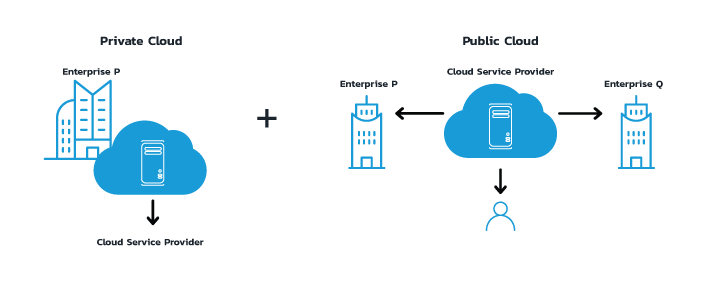
To bridge the gap between a local data center and the public cloud, architects must design a network that treats both environments as a single, unified entity. This requires a combination of hardware, software-defined networking (SDN), and robust encryption protocols.
The Foundation of Connectivity
The bridge begins with how the two environments physically and logically talk to each other. In 2025, there are three primary ways this is achieved:
- Dedicated Interconnect Services: Platforms like AWS Direct Connect, Azure ExpressRoute, and Google Cloud Interconnect provide a private, physical link between the enterprise and the provider. These connections bypass the public internet, offering consistent performance and significantly lower latency.
- Software-Defined WAN (SD-WAN): SD-WAN has evolved to become the preferred method for managing traffic across multiple sites. It uses software to intelligently route traffic over the best available path, whether that is a dedicated line, a broadband connection, or a 5G link.
- Virtual Private Networks (VPN): For smaller workloads or as a secondary backup, encrypted VPN tunnels over the public internet remain a cost-effective solution. Modern IPsec and WireGuard implementations ensure that even these connections meet high security standards.
The Role of Network Virtualization
Network virtualization allows administrators to manage complex routing and firewall rules from a centralized dashboard. By abstracting the network hardware, teams can deploy virtual routers and firewalls in the cloud that mirror the configurations of their on-premise equipment. This consistency is crucial for maintaining security and compliance.
Why Bridging the Gap Matters: Core Business Drivers
The motivation for investing in sophisticated hybrid networking goes beyond technical curiosity. It is a calculated business move designed to optimize costs and performance.
Data Sovereignty and Compliance
Regulations like the Digital Operational Resilience Act (DORA) in the European Union and evolving data privacy laws globally have made localized data storage a legal requirement for many. Hybrid networking allows a company to keep sensitive data on physical servers within their jurisdiction while using the public cloud to run the frontend applications that customers interact with.
Latency Optimization for Edge Computing
With the rise of 5G and IoT, processing data at the edge is more important than ever. Hybrid networking enables a “hub and spoke” model where heavy data processing occurs in a central cloud, but time-sensitive tasks are handled by on-premise “edge” nodes located closer to the end-user. This is particularly relevant in manufacturing, where milliseconds can mean the difference between a smooth assembly line and a costly mechanical error.
Disaster Recovery and Business Continuity
One of the most powerful use cases for a hybrid bridge is resilience. By maintaining a synchronized copy of critical data in the cloud, businesses can ensure that an on-premise power outage or natural disaster does not lead to a total shutdown. The hybrid network facilitates real-time data replication, allowing for almost instantaneous failover to cloud-based resources.
Technical Deep Dive: Connectivity Strategies
Selecting the right connectivity model is the most important decision in any hybrid cloud project. Each option has its own implications for cost, security, and performance.
1. Dedicated Private Interconnects
For enterprises with large-scale data transfers or high-performance requirements, dedicated links are the gold standard.
- Performance: These links typically offer speeds ranging from 1 Gbps to 100 Gbps. Because the traffic does not compete with general internet traffic, the latency is highly predictable.
- Security: Since the data never traverses the public internet, the attack surface is significantly reduced.
- Cost Structure: These services usually involve a monthly port fee plus data egress charges. However, cloud providers often offer lower egress rates for dedicated connections compared to the public internet, which can save large enterprises thousands of dollars annually.
2. Multi-Cloud SD-WAN Integration
As companies adopt more than one cloud provider, the network becomes a complex web. SD-WAN acts as the “brain” of this web. It can recognize the type of traffic (e.g., a video call versus a background database sync) and prioritize the most important packets.
In 2025, “Cloud-Native SD-WAN” has become a dominant force. This technology allows the SD-WAN controller to exist within the cloud itself, providing a unified management plane for every branch office, data center, and cloud region.
3. IPsec VPN Tunnels
VPNs are the quickest way to establish a bridge. They are ideal for:
- Initial development and testing phases.
- Small branch offices with limited bandwidth needs.
- Secondary failover paths for dedicated circuits.
The main drawback of VPNs is their reliance on the public internet, which can introduce jitter and variable latency.
The Security Imperative: Implementing Zero Trust
In a hybrid environment, the traditional “castle and moat” security model is obsolete. There is no longer a clear “inside” or “outside” to the network. Instead, security teams in 2025 are adopting the Zero Trust Architecture (ZTA).
Identity as the New Perimeter
When bridging on-premise and cloud, identity becomes the primary way to secure the connection. Every user, device, and application must be explicitly verified before it is granted access to any resource. This is often achieved through:
- Multi-Factor Authentication (MFA): Requiring multiple forms of verification for every login.
- Microsegmentation: Dividing the network into tiny, isolated zones. If a single server is compromised, the attacker cannot “move laterally” to other parts of the network because each zone requires separate authorization.
- Endpoint Protection: Ensuring that every laptop or server connecting to the network meets specific security health standards.
Encryption in Transit and at Rest
The bridge between on-premise and cloud must be encrypted using the latest standards. In 2025, TLS 1.3 is the minimum requirement for data in motion. Advanced enterprises are also exploring post-quantum cryptography to protect their data against future decryption threats.
AI and Data Acceleration: The 2025 Hybrid Landscape
The explosion of Generative AI has transformed hybrid networking requirements. Training a large language model (LLM) requires massive GPU clusters usually found in the public cloud. However, the data used to fine-tune these models often contains proprietary intellectual property that must stay on-premise.
The AI Factory Model
Forward-thinking companies are building “AI Factories.” In this model, the hybrid network acts as a high-speed data pipeline. Raw data is cleaned on-premise, sent securely to the cloud for model training, and then the finalized, compact model is sent back to the on-premise environment for “inference” (the actual task of answering queries).
This cycle requires massive bandwidth and extremely low latency to ensure that the data pipeline doesn’t become a bottleneck for the AI’s performance.
Common Challenges in Hybrid Cloud Networking
Despite the benefits, building this bridge is not without its obstacles. Understanding these challenges is the first step toward overcoming them.
1. The Data Egress Trap
Public cloud providers often make it free or very cheap to move data into their cloud (ingress). However, they charge fees to move data out of their cloud (egress). In a hybrid environment where data moves back and forth constantly, these egress fees can quickly spiral out of control.
Solution: Implement “FinOps” practices. Use monitoring tools to track data flow patterns and place workloads strategically to minimize unnecessary data movement. Using dedicated interconnects can also provide discounted egress rates.
2. Network Visibility Gaps
It is difficult to troubleshoot a network problem when you can only see half of the path. If an application is slow, is it the on-premise server, the cloud database, or the bridge in between?
Solution: Deploy unified observability platforms. Tools like Datadog, New Relic, or cloud-native suites (AWS CloudWatch, Azure Monitor) now offer “cross-cloud” visibility, providing a single view of the entire hybrid path.
3. Skill Set Shortages
Managing a hybrid network requires a deep understanding of both traditional hardware networking and modern cloud-native APIs. There is currently a significant shortage of professionals who are experts in both areas.
Solution: Invest in automation. By using Infrastructure as Code (IaC) tools like Terraform or Pulumi, teams can define their network in code. This reduces the need for manual configuration and helps bridge the gap between “hardware people” and “cloud people.”
Step-by-Step Guide to Implementing a Hybrid Bridge
If you are beginning the journey of connecting your on-premise data center to the public cloud, follow this logical progression to ensure a stable deployment.
Phase 1: Assessment and Planning
Before touching any hardware, audit your existing environment.
- Identify which applications will move to the cloud and which will stay.
- Map the data dependencies. Which apps need to talk to which databases?
- Determine your bandwidth requirements. Look at peak usage, not just average usage.
Phase 2: Choosing the Connection Type
Based on your assessment, select the appropriate bridge.
- Use a VPN for the initial setup.
- Transition to a dedicated interconnect (like Direct Connect) once you have consistent, high-volume traffic.
- Implement SD-WAN if you have multiple office locations that need to access both the data center and the cloud.
Phase 3: Establishing the Identity Framework
Secure the bridge before you open the gates.
- Set up identity federation. This allows your employees to use their existing corporate login for cloud resources.
- Implement a Zero Trust policy. Start with the “Principle of Least Privilege,” giving users access only to what they absolutely need.
Phase 4: Pilot Migration and Testing
Move a non-critical application first.
- Monitor for latency and performance issues.
- Test your failover procedures. Pull the plug on the primary link and ensure the backup takes over automatically.
- Analyze the initial billing to ensure it aligns with your cost projections.
Phase 5: Full-Scale Operation and Continuous Optimization
Once the pilot is successful, move your core workloads.
- Use AI-driven monitoring to keep an eye on network health.
- Regularly review your data egress patterns to find cost-saving opportunities.
- Stay updated on new features from your cloud provider that could simplify your architecture.
Future Outlook: Networking Beyond 2025
The bridge between on-premise and public cloud will continue to evolve. Several emerging technologies are set to change the game in the coming years.
Network as a Service (NaaS)
The concept of NaaS is gaining traction. Instead of building and maintaining your own network infrastructure, you “consume” networking as a utility. This allows companies to scale their hybrid bridge up or down instantly based on demand, much like they do with cloud compute.
Multi-Cloud Mesh
As enterprises move from “Hybrid Cloud” to “Distributed Cloud,” we are seeing the rise of the Multi-Cloud Mesh. This is a layer of software that sits on top of all your clouds and data centers, making them look like one giant, global pool of resources. In this world, the underlying network becomes completely invisible to the developer.
Satellite Integration
For remote industrial sites (like oil rigs or mines), the hybrid bridge is now being extended via low-earth orbit (LEO) satellite constellations like Starlink. This allows even the most isolated on-premise environments to participate in the global hybrid cloud ecosystem.
Conclusion: The Strategic Importance of the Hybrid Bridge
Hybrid cloud networking is no longer a niche technical topic. It is a strategic imperative for any business that wants to be agile, secure, and cost-effective in the late 2020s. By bridging on-premise and public cloud environments, organizations can enjoy the best of both worlds: the massive scale of the cloud and the rock-solid control of the data center.
The key to success lies in careful planning, a commitment to Zero Trust security, and the use of modern automation tools to manage complexity. As the landscape continues to shift, the bridge you build today will be the foundation for the innovations of tomorrow.